
Have you ever seen a crypto token that promises to bridge the gap between high-frequency institutional trading and retail investors? That is exactly what Liquid MERC claims to do. If you are looking at your portfolio or browsing exchanges and see the ticker MERC, you might be wondering: Is this just another hype coin, or does it actually have a job to do?
The short answer is that Liquid Mercury (MERC) is an ERC-20 utility token designed for a specific ecosystem run by a U.S.-based trading technology firm called Liquid Mercury. It isn't built for meme culture or viral trends. Instead, it targets professional traders, OTC desks, and asset managers who need low-latency execution tools. For regular holders, the value comes from staking rewards and a unique discount system involving "Element Tokens." But before you buy in, you need to understand how this machine works, because it operates differently than most coins you know.
Who Built Liquid MERC and Why?
To understand the token, you first have to look at the company behind it. Liquid Mercury is a technology firm founded by Anthony “Tony” Saliba. If that name rings a bell, it should-Saliba was a major figure in derivatives trading during the 1990s and founded LiquidPoint, an early trading tech firm. He brings decades of traditional finance experience into the crypto space.
Liquid Mercury builds institutional-grade infrastructure. Think about the software banks and hedge funds use to execute millions of dollars in trades instantly. That is their product. They provide workflow automation, risk controls, and reporting standards that meet strict traditional finance requirements. The launch of the MERC token was their way of bringing some of these economics on-chain. Instead of handling fee discounts off-book, they created a tradable digital asset that represents access to their platform.
Tokenomics: Supply, Circulation, and Market Data
Let's talk numbers, because the supply structure matters here. MERC has a fixed maximum supply of 6,000,000,000 tokens. This number never changes. However, not all of those tokens are floating around right now.
Data aggregators like CoinGecko and Kraken show different circulating supply figures, which can be confusing. Some reports cite around 2.1 billion tokens in circulation, while others list closer to 3.14 billion. This discrepancy usually happens because different platforms define "circulating" differently-some include locked staking balances, while others only count freely tradeable wallets. Regardless of the exact float, the market cap remains relatively small compared to top-tier cryptos.
| Metric | Value / Status |
|---|---|
| Blockchain | Ethereum (ERC-20) |
| Max Supply | 6,000,000,000 MERC |
| Circulating Supply | ~2.1B - 3.15B (varies by source) |
| All-Time High | ~$1.00 USD |
| Current Price Range | $0.0018 - $0.0060 USD (Highly volatile) |
Price history shows significant volatility. MERC hit an all-time high near $1.00 but has since dropped over 99% to sub-cent levels. You will also notice thin liquidity. On decentralized exchanges like Uniswap V3, daily volume can sometimes dip below $1,000. This means if you try to sell a large amount of MERC at once, you could move the price significantly against yourself. Always check the order book depth before executing trades.
How MERC Actually Works: The Discount Farming Model
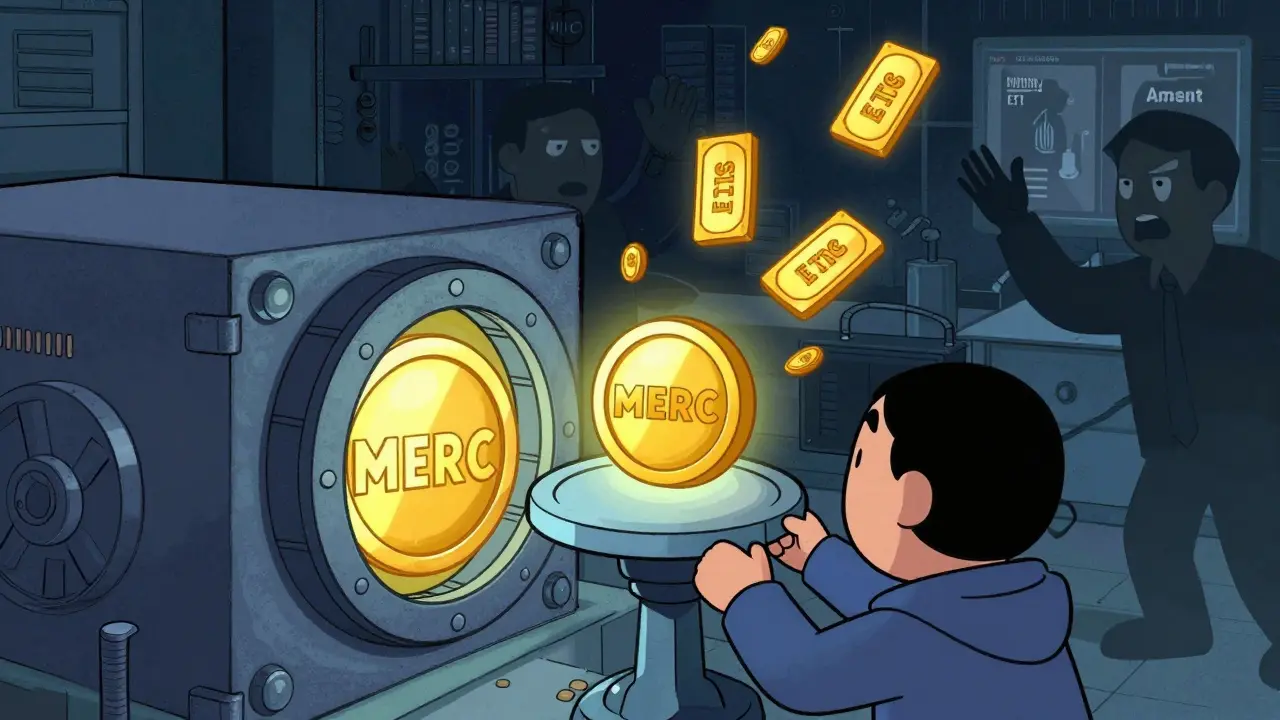
This is the part that sets MERC apart from standard governance tokens. The core utility revolves around a mechanism called Discount Farming. Here is how it functions step-by-step:
- Stake MERC: You lock your MERC tokens into Liquid Mercury’s staking contract.
- Earn Element Tokens (ETs): In return, you receive monthly distributions of ETs based on how much you staked and for how long.
- Use or Sell ETs: ETs act as credits. Institutional clients of Liquid Mercury use them to pay for services like order routing, algorithmic execution, and analytics. If you are not an institutional client, you can sell your ETs on a private secondary marketplace to those who are.
Additionally, stakers receive a direct reward of 10% APY paid in MERC tokens. This creates a dual-income stream: you get new MERC tokens plus ET credits that have real purchasing power within the Liquid Mercury ecosystem.
Why does this matter? It aligns incentives. Institutions want cheaper fees, so they buy ETs. Retail holders provide those ETs by staking MERC. It turns the right to a fee discount into a tradeable commodity.
The Future Bet: Real World Assets (RWAs)
Liquid Mercury isn't stopping at crypto trading. Their roadmap heavily features Real World Assets (RWAs). They plan to build marketplaces for tokenized commodities, private equity stakes, and even collectibles.
In these future markets, MERC will serve two critical roles:
- Transactional Currency: Paying transaction fees for buying/selling tokenized assets.
- Governance Token: Voting on which assets get listed, setting margin requirements, and adjusting fee schedules.
Industry giants like Boston Consulting Group (BCG) and Citigroup have projected that the tokenized asset market could reach trillions of dollars by 2030. Liquid Mercury is betting big on this trend. If they successfully capture institutional flow in regulated RWAs, the demand for MERC could shift from simple fee discounts to essential protocol utility.
Risks You Need to Know Before Buying
No investment is without risk, and MERC carries several specific ones that require careful consideration.
Centralization Risk: Unlike fully decentralized protocols where code is law, MERC relies heavily on Liquid Mercury the company. The ET marketplace is private and off-chain. If the company faces legal trouble, loses clients, or shuts down operations, the utility of MERC-and the value of your ETs-could evaporate quickly.
Liquidity Constraints: As mentioned earlier, trading volume is low. Slippage is real. Moving in and out of positions costs more in percentage terms than it would with Bitcoin or Ethereum. This makes MERC less suitable for day-trading strategies that rely on quick exits.
Regulatory Uncertainty: Because MERC offers staking yields and potential profit participation via ETs, regulators in jurisdictions like the U.S. might view it as a security. The SEC has scrutinized similar exchange tokens in the past. Keep an eye on regulatory announcements regarding utility tokens with yield-bearing features.
Audit Transparency: While MERC runs on the secure Ethereum network, there is limited public information about third-party smart contract audits for the specific staking contracts. Always verify current audit status on Etherscan or official project documentation before locking up funds.

How to Buy and Store MERC
If you decide to proceed, here is the practical path to getting started:
Acquisition: Currently, the most reliable way to acquire MERC is through decentralized exchanges (DEXs) on Ethereum, specifically Uniswap V3. You will need ETH to pay for gas fees and to swap for MERC. While price trackers like KuCoin or Kraken may list MERC, verify if they offer actual trading pairs or just informational charts. Centralized listings are sparse.
Storage: Since MERC is an ERC-20 token, any wallet compatible with Ethereum will work. Popular choices include MetaMask, Trust Wallet, or hardware wallets like Ledger and Trezor. You will need to add the MERC contract address manually to your wallet interface to see your balance.
Staking: To activate the utility, connect your wallet to the Liquid Mercury staking dashboard. Approve the token transfer, stake your desired amount, and wait for the monthly ET distribution. Remember, your tokens are locked while staking, so only commit what you can afford to hold long-term.
Final Thoughts on Liquid MERC
Liquid MERC is a niche tool designed for a sophisticated ecosystem. It appeals to those interested in the intersection of institutional trading tech and blockchain innovation. It is not a get-rich-quick scheme; it is a utility token tied to the success of a specific B2B platform. If you believe in Tony Saliba’s vision for tokenized RWAs and institutional adoption, MERC offers exposure to that narrative. But given the low liquidity and centralization risks, treat it as a high-risk satellite position rather than a core holding.
Is Liquid MERC a good investment?
Whether MERC is a "good" investment depends entirely on your risk tolerance. It is a high-risk, high-reward asset due to its low liquidity and dependence on a single company's success. It is best suited for experienced investors who understand institutional crypto infrastructure and are comfortable with illiquid assets. It is not recommended for beginners seeking stable returns.
What are Element Tokens (ETs)?
Element Tokens (ETs) are credit instruments generated when you stake MERC. They function as fee discounts for Liquid Mercury's professional trading services. Institutional clients buy ETs to reduce their operational costs, while individual stakers earn them as rewards and can sell them on a private marketplace.
Can I withdraw my MERC anytime after staking?
Typically, staking involves a lock-up period during which you cannot withdraw your principal MERC tokens. Check the specific terms of the "Discount Farming Staking Program" on the official Liquid Mercury website for current lock durations and unstaking conditions.
Where can I trade MERC on centralized exchanges?
As of recent data, MERC primarily trades on decentralized exchanges like Uniswap V3. While it appears on price trackers for platforms like KuCoin, Kraken, and Crypto.com, availability for direct trading on these centralized venues varies and is often limited or non-existent. Always verify pair availability directly on the exchange.
How does MERC relate to Real World Assets (RWAs)?
Liquid Mercury plans to integrate MERC into its future RWA marketplaces. In this context, MERC will be used to pay transaction fees for tokenized assets (like commodities or private equity) and will grant governance rights to vote on asset listings and market parameters.






Terry Hyland
This whole thing feels like a trap. They say it is for institutions but really they just want your money. It is not right to let people lose their savings on these fake coins. The system is rigged against the little guy and we need to stop trusting these tech bros who think they are smarter than everyone else.