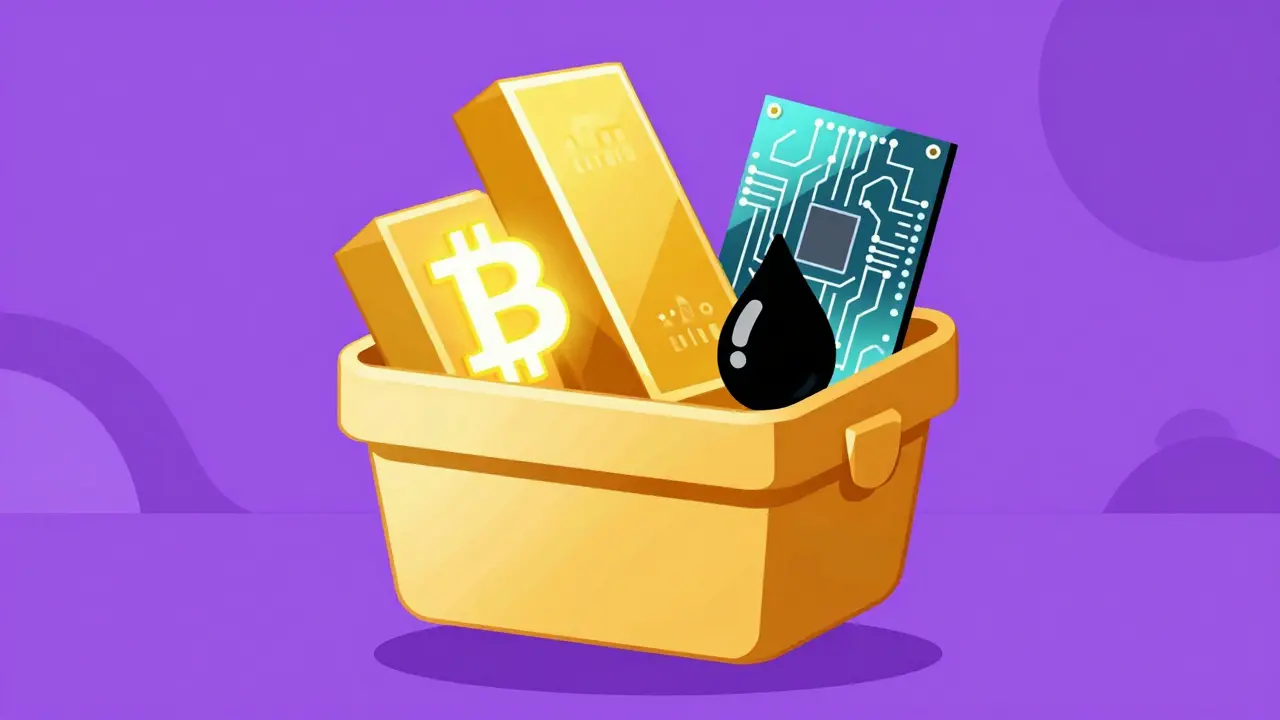
Imagine a digital coin that doesn't just bet on one horse but tries to capture the value of the entire global economy. That is the core idea behind Rabi (RABI) is a decentralized finance (DeFi) application built on the Binance Smart Chain that generates tokens soft-pegged to a mix of assets like Bitcoin, gold, oil, and tech shares. It aims to be more than just a speculative asset; it wants to be a stable store of value that doesn't crash just because one specific market dips.
But here is the catch: while the theory sounds like a financial superpower, the actual market data tells a more chaotic story. If you are looking into Rabi RABI crypto coin, you need to understand the gap between its ambitious "multi-asset" design and its actual performance in the wild. Let's break down how it works, where it stands in 2026, and why its price history looks like a mountain peak followed by a cliff.
The Mechanics of the Rabi Protocol
Most stablecoins you know, like USDT or USDC, are pegged to a single currency-usually the US Dollar. Rabi is different. It uses a "soft-peg" mechanism. Instead of mirroring one thing, it tries to balance its value against a basket of diverse assets. We are talking about Bitcoin, physical gold, crude oil, the USD, and shares from big tech companies.
The project was spearheaded by Bentzi Rabi and Sam Eiderman. The goal was to create a token that could serve four primary financial roles:
- Store of Value: Keeping wealth safe over the long term.
- Medium of Exchange: Being used to buy goods or services.
- Unit of Account: A way to measure the price of other things.
- Standard of Deferred Payment: A reliable way to handle future debts.
To make this happen efficiently, they built the Rabi Protocol is the core infrastructure that manages the collateral backing and the generation of RABI tokens. By running on the Binance Smart Chain (BSC), the protocol keeps transaction fees low and speeds high, which is essential for a token that's supposed to be used for frequent transactions.
Price Reality Check: The 2026 Landscape
If you check the charts today, April 11, 2026, you will see a fragmented picture. Depending on where you look, the price of RABI is hovering around $0.0007. For instance, CoinMarketCap shows it at $0.000741, while CoinGecko lists it slightly higher at $0.000751. Why the difference? It comes down to liquidity. When a coin isn't traded in massive volumes, small trades on different exchanges can cause the price to vary significantly.
The historical data is where things get intense. In January 2025, RABI hit an all-time high of $0.62. Since then, it has plummeted by roughly 99.90%. For any investor who bought at the peak, the loss is nearly total. Even though the current price is about 27% above its all-time low, the token is essentially a ghost of its former peak value.
| Metric | Value / Status | Context |
|---|---|---|
| Current Price | ~$0.00074 | High variance across exchanges |
| All-Time High | $0.62 | Reached January 20, 2025 |
| Max Supply | 1 Billion RABI | Determines the Fully Diluted Valuation |
| Primary Network | Binance Smart Chain | Low-cost BEP-20 standard |
| Main Exchange | BitMart | Highest relative trading volume |
Where Can You Actually Use RABI?
The vision for RABI extends beyond just holding it in a wallet. The developers have positioned it for several specific niches. For example, in the world of Prediction Markets is a platform where users bet on the outcome of future events, RABI could theoretically act as a stable collateral. Similarly, its intended use in gaming and cross-border transactions aims to remove the friction of converting multiple currencies.
One interesting aspect is the Rabi Foundation. Unlike many crypto projects where a central team keeps control forever, the foundation intends to dissolve itself. The plan is to hand the keys over to the community once the protocol can manage its own governance autonomously. This is a move toward "true decentralization," meaning no single person or company would be the point of failure.

The Trade-Offs: Theory vs. Practice
On paper, pegging a coin to gold, oil, and Bitcoin sounds like a hedge against everything. If Bitcoin drops, maybe oil rises. If the dollar weakens, gold climbs. But in reality, RABI has struggled to maintain this stability. The massive crash from $0.62 to a fraction of a cent proves that a "soft-peg" is only as strong as the market's trust in it.
When you trade RABI on a centralized exchange like BitMart, you are dealing with limited liquidity. For a token to be a true "medium of exchange," you need to be able to buy and sell millions of dollars' worth without moving the price. Currently, RABI's 24-hour volume (often under $100,000) is too low for institutional use and risky for large retail traders.
Common Pitfalls and Pro Tips
If you are considering RABI, keep these rules of thumb in mind:
- Watch the Volume: Don't just look at the price. Check the 24-hour trading volume. If it's low, you might find it hard to sell your tokens without crashing the price further.
- Network Compatibility: Ensure you are using a wallet that supports the BNB platform, as RABI is a BEP-20 token. Sending it to a non-compatible address means your funds are gone forever.
- Manage Expectations: Price predictions have been conservative, with some models suggesting very slow growth (around 5% annually). Don't expect a return to the 2025 highs based on current data.
What makes Rabi different from a standard stablecoin?
Standard stablecoins usually peg to one asset, like the US Dollar. Rabi uses a multi-asset pegging mechanism, meaning its value is tied to a basket of assets including Bitcoin, gold, oil, and tech stocks to reduce volatility.
Is RABI a safe investment?
Crypto investments are inherently risky. RABI has shown extreme volatility, including a 99.90% drop from its all-time high in January 2025. Its low liquidity on exchanges further increases the risk for traders.
Which blockchain does Rabi use?
Rabi is built on the Binance Smart Chain (BSC), allowing it to benefit from faster transaction speeds and lower gas fees compared to the Ethereum network.
Where can I buy RABI tokens?
RABI is primarily traded on centralized exchanges, with BitMart being one of the most prominent venues for the RABI/USDT pair.
Who founded the Rabi project?
The project was founded by Bentzi Rabi and Sam Eiderman, who combined expertise in finance and blockchain technology to develop the multi-asset pegging strategy.


Samson Selleck
The fundamental flaw here is the naive assumption that a soft-peg can mitigate systemic volatility without a robust algorithmic stabilization mechanism. Looking at the slippage on BitMart, the liquidity profile is absolutely abysmal, making the entire concept of a "medium of exchange" a complete joke. You cannot have an efficient market when the order book is this thin. The delta between the theoretical multi-asset backing and the actual market cap is an embarrassment to DeFi architecture. It's essentially a fancy wrapper around a failing asset class with zero real-world utility. Most of these retail traders are just exit liquidity for the founders. The lack of transparency regarding the actual collateralization ratio is the real red flag here. If the backing isn't audited on-chain in real-time, the "soft-peg" is just a marketing term for "we hope it stays stable." The 99% drop isn't a dip; it's a total failure of the protocol's economic model. You don't recover from that without a complete hard fork or a massive burn mechanism. The current valuation is purely speculative and detached from any intrinsic value. It's a classic case of over-engineering a product that nobody actually needs. Truly pathetic execution of a moderately interesting idea.