Trading on Ethereum mainnet used to mean paying more in gas fees than the profit you made from your trade. That changed with Layer 2 solutions like Optimism, a scaling network that slashes transaction costs by up to 99% compared to Ethereum's base layer. But speed and low cost are only half the battle in decentralized finance (DeFi). The other half is efficiency. This is where Sushiswap v3, specifically its deployment on Optimism, enters the chat.
You might be wondering why you should care about Sushiswap when Uniswap dominates the space. The answer lies in how rewards are distributed. While most exchanges give all trading fees directly to liquidity providers, Sushiswap splits the pie differently. It keeps a slice for its token stakers. For some, this is a dealbreaker. For others, it’s an opportunity to earn passive income without locking up massive amounts of capital. Let’s break down exactly how Sushiswap v3 works on Optimism, who it is for, and whether it can actually compete with the giants.
What Is Sushiswap v3 on Optimism?
Sushiswap is a decentralized exchange (DEX) protocol. Version 3 represents a major technical shift from its predecessor, V2. Instead of spreading your liquidity across every possible price point, V3 uses concentrated liquidity, a mechanism that lets you allocate funds within specific price ranges. Think of it like parking your car in a garage closer to the exit rather than leaving it in a distant lot; your capital works harder because it’s positioned where trades are actually happening.
When Sushiswap deployed this technology on Optimism in late 2023, it combined two powerful elements: the high-efficiency architecture of V3 and the ultra-low gas fees of Optimism. On Ethereum mainnet, adjusting your liquidity position could cost $10 or more. On Optimism, that same action often costs less than five cents. This makes active management-moving your range as prices shift-financially viable for smaller investors, not just whales.
The platform supports multiple fee tiers: 0.01%, 0.05%, 0.30%, and 1.00%. These tiers cater to different types of assets. Stablecoin pairs like USDC/USDT usually sit in the 0.01% tier because their prices don’t fluctuate wildly. Volatile pairs like ETH/USDT typically use the 0.30% tier. Choosing the right tier is crucial because it determines how much you earn per trade, but also dictates the risk level of impermanent loss.
How the Reward Structure Differs from Uniswap
This is the part that confuses new users. In a standard DEX like Uniswap v3, if a trader pays a 0.30% fee, 100% of that fee goes to the Liquidity Providers (LPs). Simple, right? Sushiswap does something different. It takes a cut.
| Fee Component | Uniswap v3 Allocation | Sushiswap v3 Allocation |
|---|---|---|
| Liquidity Providers (LPs) | 100% of collected fees | 83.3% of collected fees (e.g., 0.25% of a 0.30% fee) |
| Protocol/Stakers | 0% | 16.7% of collected fees (e.g., 0.05% of a 0.30% fee) |
| Recipient of Protocol Share | N/A | xSUSHI stakers (SUSHI token holders) |
So, why would anyone choose Sushiswap over Uniswap? Two reasons. First, if you hold xSUSHI tokens, you earn a share of these protocol fees simply by staking them. You don’t need to provide liquidity yourself; you benefit from the activity of others. Second, Sushiswap offers the Onsen Program, which provides additional SUSHI token incentives for providing liquidity to new or emerging pools. During our research, we found APYs in these incentivized pools ranging from 8% to 45%, far exceeding what pure fee-based models offer in early stages.
However, there is a trade-off. Because Sushiswap has lower total volume than Uniswap on Optimism, the raw fee earnings per dollar provided might be lower unless you catch those Onsen bonuses. According to data from late 2025, Uniswap held about 65% of the market share on Optimism, while Sushiswap hovered around 12%. Volume drives fees, so fewer traders mean fewer fees to split among LPs.
Concentrated Liquidity: Power Tool or Trap?
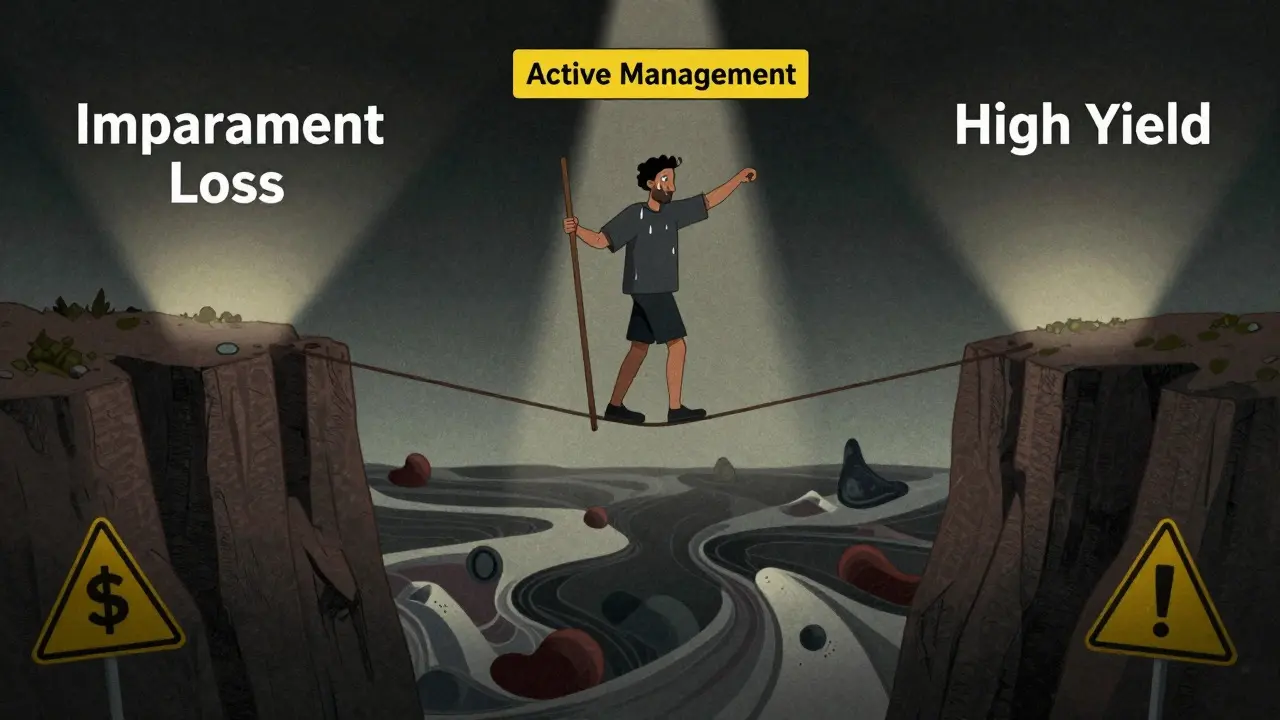
Let’s talk about the elephant in the room: impermanent loss. When you provide liquidity in a V3 pool, you define a price range. If the asset price stays within that range, you earn fees efficiently. If the price moves out of that range, your position stops earning fees, and you may suffer impermanent loss-a temporary reduction in value compared to just holding the assets.
In V2, this was a slow burn. In V3, it can happen fast. Imagine you set a tight range for ETH between $3,000 and $3,200. If ETH jumps to $3,500, your liquidity is no longer "in range." Your position converts entirely to the asset that lost value relative to the pair. Without intervention, you miss out on the rally and eat the loss.
Experienced users love this mechanic. A Reddit user reported achieving a 22% APY on a stablecoin pair by tightly managing their range between 0.999 and 1.001. But beginners often get burned. One user shared losing 8% during an ETH volatility spike because they didn’t adjust their range quickly enough. The key takeaway? Concentrated liquidity requires active management. It is not a "set it and forget it" strategy.
Performance Metrics and User Experience
Does it actually work well in practice? From a technical standpoint, yes. Transaction confirmation times on Optimism average around 2 seconds. Gas fees are consistently under $0.05. This makes frequent rebalancing affordable. If you want to move your liquidity range three times a day, the cost is negligible.
User feedback is mixed, largely due to the learning curve. Trustpilot reviews average 3.8 out of 5 stars. Positive reviews frequently mention the ease of staking xSUSHI for extra rewards. Negative reviews almost always cite confusion over the V3 interface. Terms like "ticks," "range," and "impermanent loss" are thrown at new users without sufficient hand-holding.
The interface itself is clean but dense. Connecting your wallet (like MetaMask) is straightforward, but setting up a pool requires understanding tick math. Sushiswap’s documentation helps, but many experts recommend studying Uniswap’s educational resources first since the underlying mechanics are identical. The community support in Discord is responsive, with average reply times under 15 minutes, which is a lifesaver when you’re stuck mid-transaction.
Who Should Use Sushiswap v3 on Optimism?
Not everyone needs Sushiswap. Here is a quick breakdown of who benefits and who should look elsewhere.
- Best for: Experienced DeFi users who understand impermanent loss and want to optimize yields through active range management.
- Best for: SUSHI token holders looking to generate passive income from protocol fees via xSUSHI staking.
- Best for: Traders seeking deep liquidity on specific pairs like WBTC/USDT, which often have better depth on Sushiswap than smaller competitors.
- Avoid if: You are a complete beginner to DeFi. Start with V2 pools or simple staking until you grasp price ranges.
- Avoid if: You prefer "passive" investing. V3 requires monitoring. If you won’t check your portfolio weekly, your capital may go out of range and stop earning.
Risks and Regulatory Considerations
DeFi is not risk-free. Beyond market volatility, there are smart contract risks. While Sushiswap is audited, bugs can still exist. Always start with small amounts to test the waters. Additionally, regulatory landscapes are shifting. As of late 2025, the SEC has scrutinized certain concentrated liquidity models, though Sushiswap’s decentralized governance structure offers some legal protection under current interpretations of the Howey Test. Keep an eye on legal updates, especially if you are a large-scale provider.
Another risk is liquidity fragmentation. With so many DEXes on Optimism (Velodrome, Aerodrome, Uniswap), liquidity is spread thin. Sushiswap v3 on Optimism holds about 2.3% of the network’s Total Value Locked (TVL). While respectable, it means slippage can be higher during volatile market movements compared to Uniswap’s deeper pools.
Final Verdict
Sushiswap v3 on Optimism is a sophisticated tool for yield optimization. It isn’t the biggest player, nor is it the simplest. But for those willing to learn the mechanics of concentrated liquidity, it offers a unique dual-reward system that Uniswap lacks. If you hold SUSHI, it’s practically mandatory to stake it. If you’re a liquidity provider, it’s worth testing with stablecoins first to master the range management before diving into volatile pairs.
The future looks interesting too. Planned integrations with Optimism’s Bedrock upgrade and expansions of the Onsen Program suggest the team is actively working to close the gap with competitors. Just remember: in V3, attention is your most valuable asset. Don’t let your liquidity sleep.
Is Sushiswap v3 safe to use on Optimism?
Yes, Sushiswap v3 is generally considered safe, having undergone multiple audits. However, like all DeFi protocols, it carries smart contract risks. The primary risk for users is not hacking, but user error-specifically mismanaging concentrated liquidity ranges, which can lead to significant impermanent loss. Always verify contract addresses and start with small amounts.
How do I reduce gas fees when using Sushiswap v3?
By using the Optimism network. Sushiswap v3 on Optimism leverages Layer 2 technology, reducing gas fees by approximately 99% compared to Ethereum mainnet. Transactions typically cost less than $0.05. Ensure your wallet (e.g., MetaMask) is configured to the Optimism network (Chain ID 10) before interacting with the app.
What is the difference between Sushiswap v2 and v3?
V2 uses full-range liquidity, meaning your funds are available at any price point from zero to infinity. V3 uses concentrated liquidity, allowing you to focus your capital in a specific price range. This increases capital efficiency and potential fees for V3, but requires active management to avoid impermanent loss and going out of range.
Can I earn SUSHI tokens by providing liquidity?
Yes, through the Onsen Program. Sushiswap offers additional SUSHI token incentives for liquidity providers who support new or specific pools. These rewards can significantly boost your APY, sometimes reaching 40%+, but are subject to change based on governance decisions and pool performance.
Why does Sushiswap take a cut of the trading fees?
Sushiswap allocates 0.05% of each trade (on a 0.30% fee tier) to xSUSHI stakers. This creates a flywheel effect: stakers benefit from protocol growth, which encourages them to hold and stake SUSHI, securing the network. In return, LPs receive slightly less in direct fees compared to Uniswap, but gain access to the broader Sushiswap ecosystem and Onsen incentives.
Which fee tier should I choose for stablecoins?
For stablecoin pairs like USDC/USDT or DAI/USDC, the 0.01% fee tier is recommended. Since stablecoins maintain a peg near $1.00, their price movement is minimal. The 0.01% tier captures high-volume, low-spread trades efficiently, minimizing impermanent loss risk while maximizing fee accumulation.
Is Sushiswap v3 better than Uniswap v3 on Optimism?
It depends on your goals. Uniswap v3 has higher volume and deeper liquidity, making it better for large trades and pure fee earnings. Sushiswap v3 is better for SUSHI token holders (via xSUSHI staking) and those seeking Onsen program incentives. If you prioritize maximum liquidity depth, Uniswap wins. If you want ecosystem rewards, Sushiswap has an edge.