
Have you ever wondered where your data actually lives when you upload it to the cloud? Most of us just click 'save' and hope for the best. But in a world where privacy breaches are daily news, that trust feels risky. Enter Ethernity CLOUD, a project promising to change how we handle data security using blockchain technology. It sounds like a dream: private, anonymous, and decentralized storage. But is it the next big thing in Web3, or just another forgotten coin from the last bull run?
The short answer is complicated. Ethernity CLOUD, represented by the ticker symbol ECLD, aims to be a secure, decentralized cloud computing platform. However, looking at its current market position, technical adoption, and price history, it’s a story of ambitious tech struggling against harsh market realities. If you’re holding ECLD or thinking about buying it, you need to understand exactly what this project is-and isn’t-before making any moves.
What Exactly Is Ethernity CLOUD?
At its core, Ethernity CLOUD is a utility cryptocurrency token powering a decentralized, private, and anonymous cloud computing platform designed to protect user data through advanced encryption and blockchain technology. Unlike traditional cloud providers like AWS or Google Cloud, which store your data on centralized servers owned by one company, Ethernity splits data across a network of nodes. This makes it much harder for hackers to steal information because there is no single point of failure.
The project focuses on three main pillars:
- Encrypted Data Processing: Your data stays encrypted even while it’s being used, not just when it’s sitting idle.
- Anonymity: Users can interact with the network without revealing their identity.
- Continuous Availability: The system uses self-replicating nodes that automatically spread across the internet, ensuring the service stays up even if some nodes go offline.
This approach falls under the umbrella of confidential computing, a growing field in cybersecurity. The idea is that businesses, especially those handling sensitive info like healthcare records or financial data, can process information without ever exposing the raw data to the cloud provider itself.
How Does the Technology Work?
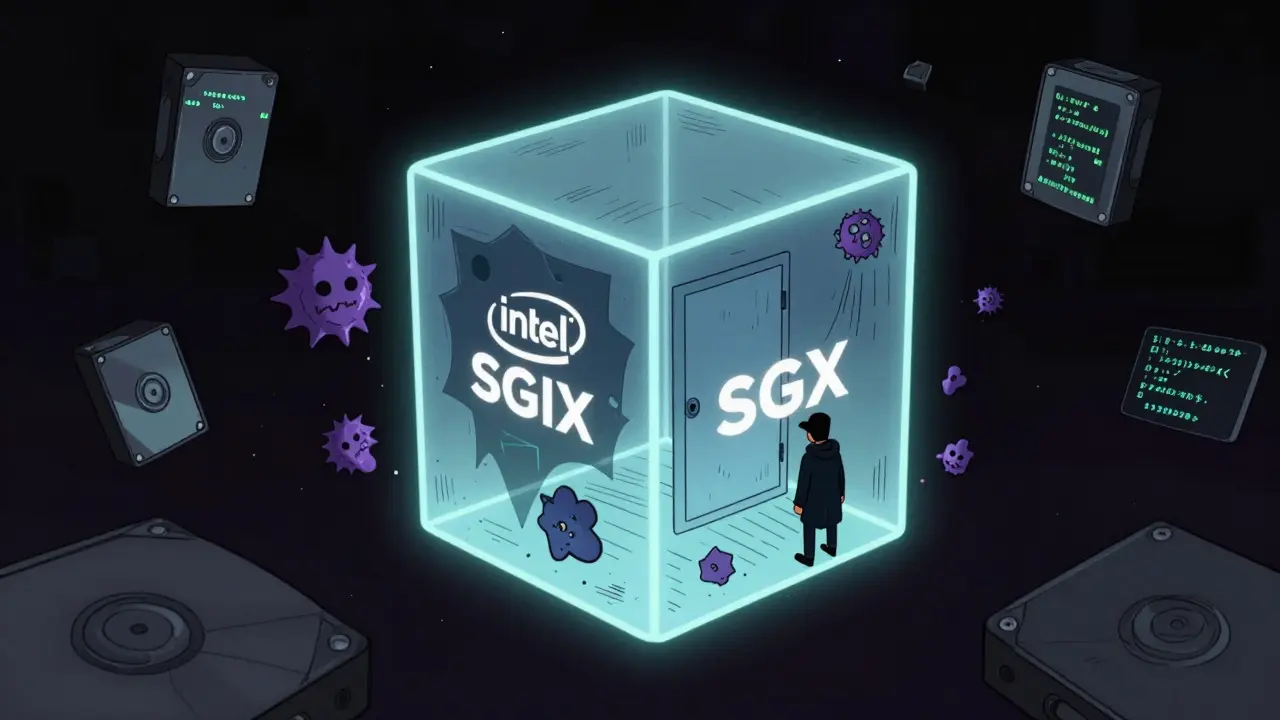
To pull off this level of security, Ethernity relies on some serious hardware and software tricks. The most critical piece is Intel SGX (Software Guard Extensions). Think of Intel SGX as a tiny, locked room inside your computer’s processor. Even if someone hacks the operating system or the cloud server, they can’t see what’s happening inside that locked room. Ethernity uses this to ensure that data remains private during processing.
But hardware alone isn’t enough. The platform also integrates several other technologies:
- IPFS (InterPlanetary File System): A protocol for storing files in a distributed way, preventing censorship and data loss.
- Docker Containers & Vagrant Virtualization: These allow the cloud services to run consistently across different machines, making the network flexible and scalable.
- Ethereum-Compatible Smart Contracts: These automate payments and agreements between users and node operators without needing a middleman.
The result is a system where nodes are "location agnostic." They spawn around the internet automatically, creating a resilient mesh network. For developers, Ethernity offers an SDK (Software Development Kit) that supports Node.js and Python, making it easier to build apps on top of this infrastructure. They’ve also introduced a decentralized DNS system with .ecld domains on Polygon and .etny domains on the bloxberg network, adding another layer of Web3 identity to the ecosystem.
Tokenomics: The ECLD Coin Explained
Every crypto project needs a token, and Ethernity’s is called ECLD. It’s classified as a utility token, meaning it’s meant to be used within the ecosystem rather than just held as an investment. Here are the key numbers you need to know:
| Metric | Value |
|---|---|
| Total Supply | 1,000,000,000 (1 Billion) |
| Circulating Supply | ~520,000,000 - 532,735,986 |
| Token Type | Utility, Multichain |
| Staking | No |
| Networks | Ethereum-compatible chains, Polygon |
The fixed supply of 1 billion tokens means no new coins will ever be minted, which theoretically prevents inflation. However, since staking is disabled, holders don’t earn passive income by locking up their tokens. The multichain nature allows ECLD to operate across different blockchains, improving accessibility but potentially fragmenting liquidity.
Market Performance: A Steep Decline
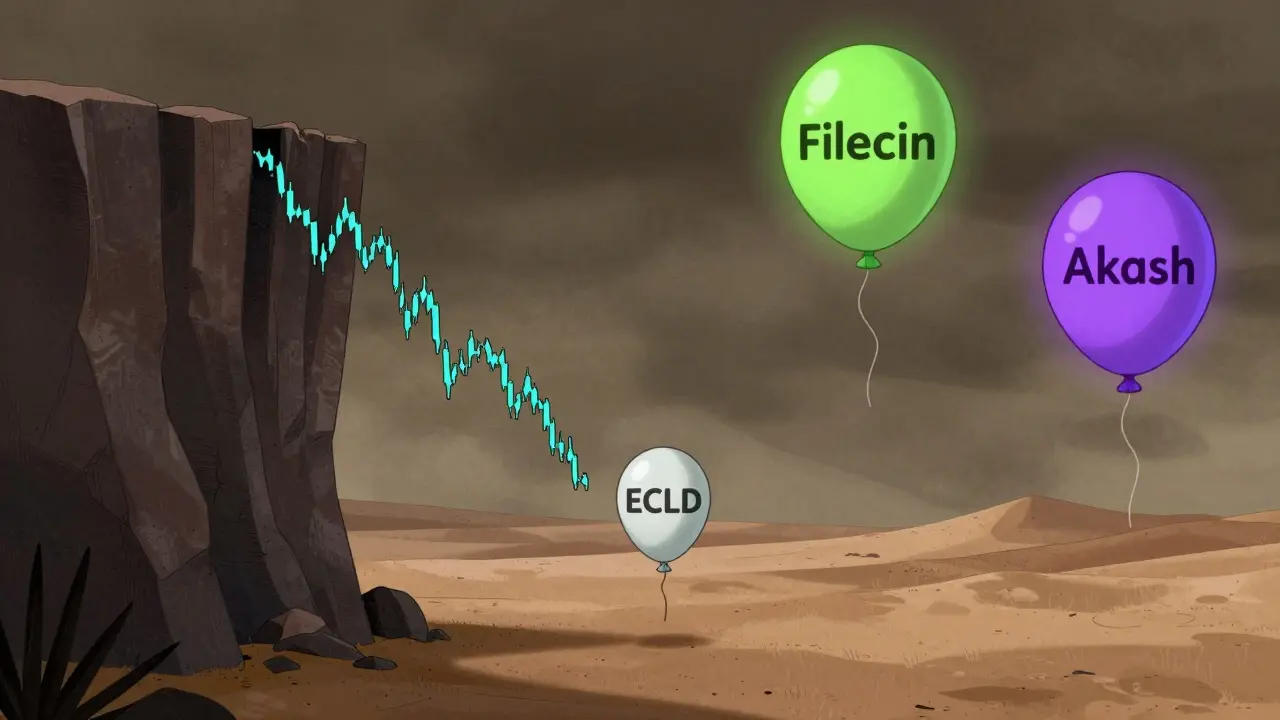
If you look at the price chart for ECLD, it’s a sobering sight. The token hit an all-time high of $0.07643 USD back in its early days. As of late 2023 and into 2024, the price has plummeted to fractions of a cent, hovering between $0.00035 and $0.00072 depending on the exchange.
That represents a drop of over 99% from its peak. To put that in perspective, if you had invested $1,000 at the top, it would now be worth less than $10. This massive decline isn’t unique to ECLD; many small-cap altcoins suffered similar fates after the 2021 bull market ended. But ECLD’s situation is particularly stark because of its lack of recovery.
Why did it crash? Several factors come into play:
- Lack of Liquidity: Trading volume is extremely low. In November 2023, the 24-hour trading volume was reported at a mere $497. This means there aren’t many buyers or sellers, making it hard to move large amounts of money without crashing the price further.
- Low Market Cap: With a market capitalization ranging from $160k to $360k, ECLD ranks outside the top 4,000 cryptocurrencies on major trackers like CoinGecko. This puts it in the "micro-cap" category, where projects often struggle to gain visibility.
- Competition: The decentralized cloud space is crowded. Projects like Filecoin, Akash Network, and Storj have significantly larger communities, higher liquidity, and more established partnerships.
Is Ethernity CLOUD Still Relevant?
Despite the terrible price performance, the technology behind Ethernity CLOUD hasn’t disappeared. The team continues to work on version 2.0 of their protocol, focusing on adapting to Intel TDX (Trusted Domain Extensions), the successor to SGX. This shows a commitment to keeping the tech stack modern.
However, relevance in the crypto world isn’t just about code; it’s about adoption. There are very few public case studies of major enterprises using Ethernity CLOUD for their data needs. Without real-world usage, the demand for the ECLD token remains weak. Analysts from platforms like LiteFinance and Wallet Investor have offered cautious projections, predicting only marginal growth. One forecast suggests ECLD might reach $0.0008 by 2035-a modest increase that barely covers inflation.
Community sentiment is mixed. On forums like Reddit and CryptoSlate, discussions are sparse. When they do appear, users often praise the concept of confidential computing but criticize the tokenomics and lack of marketing. One common sentiment is: "The concept is solid, but the execution and adoption are lacking."
Risks and Considerations for Investors
If you’re considering ECLD, you need to be aware of the risks. First, the liquidity crisis is real. With such low trading volume, you might find it difficult to sell your tokens quickly, especially if you hold a significant amount. Second, the regulatory landscape for data privacy is tightening. While Ethernity claims to offer GDPR and HIPAA-compliant solutions, they haven’t published independent audits or certifications to prove this. For enterprise clients, these documents are non-negotiable.
Finally, compare ECLD to its competitors. Akash Network, for example, has a market cap in the hundreds of millions and a vibrant developer community. Filecoin processes terabytes of data daily. Ethernity CLOUD, by contrast, operates in the shadows. Unless there’s a sudden surge in demand for confidential computing specifically tied to this platform, the token is likely to remain a niche asset with limited upside potential.
Is Ethernity CLOUD (ECLD) a good investment in 2026?
Based on current market data, ECLD is considered a high-risk, low-liquidity asset. It has lost over 99% of its value from its all-time high and has minimal trading volume. While the technology is interesting, there is little evidence of widespread adoption or strong investor interest. Most analysts predict only marginal growth, making it unsuitable for conservative investors.
What is the difference between Ethernity Chain (ETNY) and Ethernity CLOUD (ECLD)?
Ethernity Chain (ETNY) is a separate Layer-1 blockchain focused on NFTs and gaming, known for its hybrid consensus mechanism. Ethernity CLOUD (ECLD) is a distinct project focused on decentralized, confidential cloud computing. Although they share the "Ethernity" name and may have originated from the same team, they serve different purposes and have separate token economies.
How does Ethernity CLOUD protect user data?
Ethernity CLOUD uses Intel SGX (and soon Intel TDX) to create secure enclaves within processors. This ensures that data remains encrypted even while being processed. Combined with IPFS for storage and decentralized nodes, it prevents any single entity from accessing raw user data, offering a higher level of privacy than traditional centralized clouds.
Can I stake ECLD tokens to earn rewards?
No, according to official documentation, staking is not available for ECLD tokens. The token is primarily a utility asset used for paying for cloud services and transactions within the ecosystem. Holders do not receive passive yield from locking up their coins.
Who are the main competitors to Ethernity CLOUD?
Key competitors in the decentralized cloud and storage space include Filecoin (FIL), Akash Network (AKT), Storj (STORJ), and Theta Network (THETA). These projects generally have larger market caps, higher liquidity, and more active developer communities compared to Ethernity CLOUD.